


Yoga for the Whole Family: What the Practice Actually Teaches

September is National Yoga Month. Which I also only recently learned was a thing. So here we are.
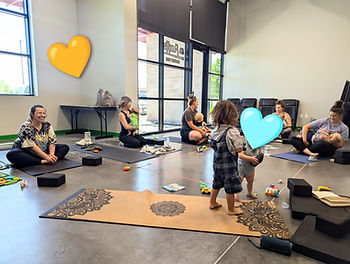
When most people hear the word yoga they think of the physical poses, the asanas. Maybe meditation. Those are two real and valuable components. But yoga is a much larger system than what happens on a mat. And many of its core principles apply directly to parenthood in ways that feel less like ancient philosophy and more like practical daily wisdom.
Breath Is Life
Let's start with a fundamental element of any yoga practice: the breath.
There's a story that has stuck with me from a kids yoga teacher training I'm taking. The mind, the eyes, and the breath were debating who was most important to the body. Unable to decide, they sought the counsel of a wise person who suggested they each take a turn leaving the body to find out. The eyes left and the body could no longer see. The mind left and the body could no longer think. Then the breath left. And immediately the eyes stopped seeing, the mind stopped working, everything ceased. They all called the breath back at once. Because breath is life.

In yoga the breath is called prana, which translates to life force or vital energy. It's the one part of the autonomic nervous system we can consciously control, as we've talked about throughout this blog series. And it's available in any moment, no mat required.
We've been teaching our son to focus on his breath when he's having big feelings. We tell him to blow on hot soup. A long slow exhale. It works. Sometimes. And it's a good reminder to us as adults too, that the tool is always right there.
A few breath practices worth having in your family toolkit:
For little ones: blow on hot soup, blow out birthday candles, blow a pinwheel, make a stuffed animal rise and fall on your belly. Simple, playful, effective.
For parents: the 4-8 breath we've talked about throughout pregnancy and postpartum. Four count inhale, eight count exhale. Even three cycles can shift the nervous system out of reactive mode.
Non-Attachment and the Lesson of Patience

Non-attachment is where the yoga philosophy and the reality of parenthood collide most honestly for me.
Impatience is almost always connected to an expectation. An attachment to how things should go or when they should happen. When that expectation isn't met, frustration fills the gap.
Parenthood will surface every attachment you have. To schedules. To outcomes. To the way you thought things would look. A child does not care about your timeline. They are on their own developmental arc and they will teach you, over and over, that your grip on how things are supposed to go is something you get to practice releasing.
But here's something I realized with my second baby: this lesson begins before they even arrive.
Waiting for labor to start is our first introduction to patience, releasing control, and trust. And not just trust in ourselves or the process. Trust in our child. Because it is baby who decides when they are ready to be born. Not the due date. Not the calendar. Not us.
That is the first lesson of parenthood. And it arrives before we ever hold them.
I've been working on this one. I don't have it figured out. But I've seen what non-attachment looks like in my son. His ability to move through something, fully feel it, and then genuinely let it go. Not suppressing. Not performing. Just done with it and ready for what's next.
That's the practice. And it turns out children are some of the best teachers of it.
Presence and the Practice of Contentment

Yoga teaches contentment as a practice. Not the forced positivity of pretending everything is fine. A genuine settling into what is, right now, without needing it to be different.
For me this connects deeply to presence. Being fully here rather than somewhere else in your mind.
Children are extraordinary at this. My son will spot a bus on a drive before I do because he is actually looking at the world around him. He notices things I've stopped noticing. He finds genuine delight in things I've learned to overlook.
Presence as a parent is more than putting down your phone. It's also putting down the mental to-do list. The planning. The worry about what comes next. It's being actually here, in this moment, with this person in front of you.
That quality of attention is one of the most significant things you can offer a child. And it's something the yoga practice, on the mat and off it, trains directly.
Supporting Children in What They Already Know
Here's something worth sitting with: children aren't learning presence and letting go. They already know these things. They come in practicing them naturally.
The ability to fully feel something and then genuinely move on. The delight in ordinary things. The complete absorption in whatever is right in front of them.
As adults we spend years accumulating layers over those qualities. The mental to-do lists. The future planning. The overthinking. The attachment to outcomes. And then we discover yoga or meditation or therapy and spend more years trying to find our way back to what we knew at three years old.
So maybe the goal of parenting isn't to teach our children these things. Maybe it's to protect what they already have. To model it ourselves as best we can. And to let them remind us, on the days we've forgotten, what it looks like to actually be here.


Comments