


Upper Body Mobility for the Postpartum Mama

In the last post we talked about mommy wrist and the strain that repetitive holding and feeding puts on your wrists and thumbs. This post is about what's happening further up the chain. Because mommy wrist doesn't exist in isolation. It's part of a larger pattern of postpartum upper body tension that starts long before baby arrives.
The Nursing Hunch: How It Starts

Most of us are already hunching before we ever hold a baby.
Hours at a computer. Looking down at a phone. Sitting in a car. The upper back rounds forward, the chest tightens, and the shoulders creep toward the ears. The muscles across the upper back become overstretched and fatigued while the chest muscles shorten and pull everything forward. Over time this becomes the default posture.
Pregnancy amplifies all of it. As your belly grows your center of gravity shifts forward and your upper back works overtime to compensate. The weight of growing breasts pulls the shoulders forward further. We talked about this in detail in The Upper Story blog during the prenatal series.
The tension in the upper body doesn't stay isolated. It travels and affects your breathing, your energy, and your overall recovery. Opening the upper body isn't just about relieving discomfort. It's about breathing well so your body can do the work of healing.
Then you have a baby. And suddenly you're feeding them eight to twelve times a day, or more if your experience is anything like mine, in a position that rounds the shoulders forward, drops the chin toward the chest, and holds everything in sustained contraction for twenty to forty minutes at a stretch. The math adds up fast. That's potentially hours every single day in a posture your body was already struggling with.
The result is what gets called the nursing hunch. Tight chest. Rounded shoulders. Upper back that aches constantly. Neck that never fully releases. And a jaw that's been quietly clenched through all of it.
Prevention First
The most important thing you can do is set up your feeding environment to support your body rather than strain it. We covered this in the mommy wrist post but it applies equally here.
Use a U-shaped nursing pillow to bring baby up to breast height rather than hunching down to meet them. Support your own back with a pillow behind you. Keep your feet flat on the floor or supported on a footstool so your hips are at a comfortable angle. Bring baby to you rather than folding yourself around baby.
These small adjustments won't eliminate the postpartum upper body challenge entirely. But they reduce the cumulative load significantly.
Movements That Help
Here's the important thing: you don't have to do all of these. Pick two or three that feel good and do them consistently. A few intentional minutes each day is worth more than an occasional long session you never get around to.
Chest Openers

The chest is often the tightest and most neglected area in postpartum recovery. Opening it creates immediate relief and improves breathing capacity.
Cactus Arms: Lie on your back or stand against a wall. Bend your elbows to 90 degrees with palms facing forward, like a goalpost. Let gravity or the wall gently draw your elbows back. Hold for 30 to 60 seconds and breathe into the front of your chest.
Doorway stretch: Stand in a doorway with one hand on each side at shoulder height. Step one foot forward gently until you feel a stretch across the chest. Hold for 30 seconds each side.
Thoracic Mobility
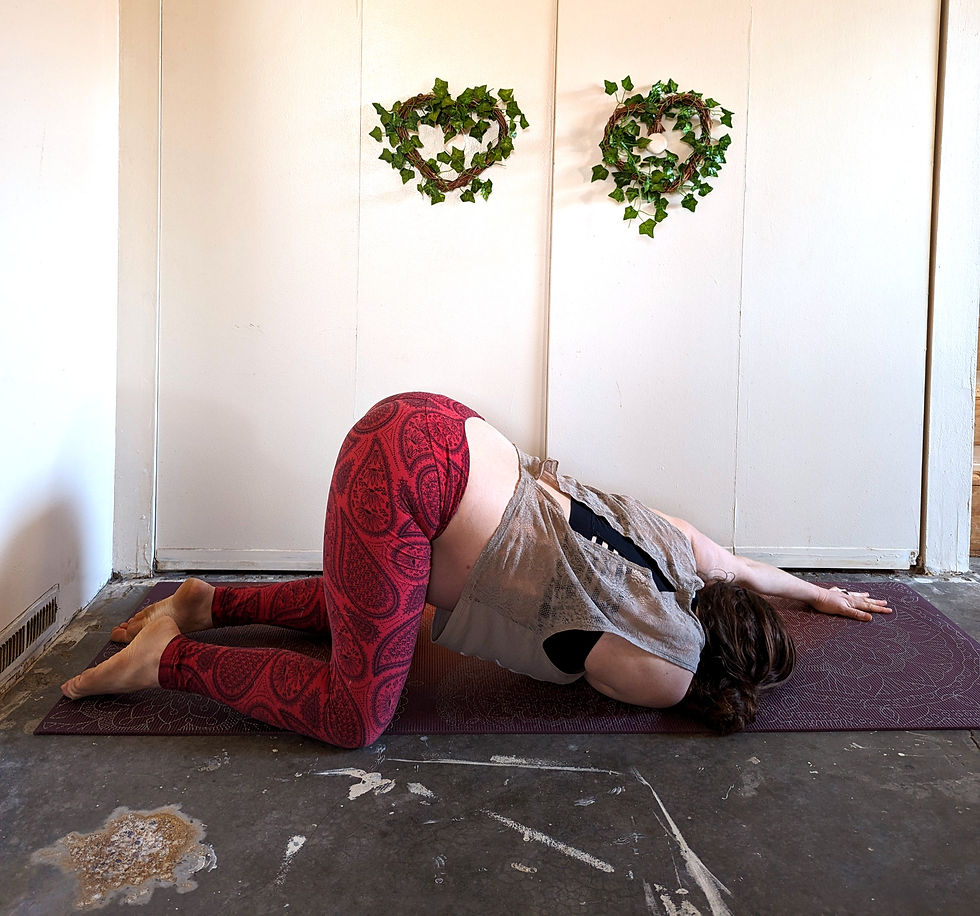
The thoracic spine, the middle and upper back, is where most of the rounding happens and where most people have the least mobility. Moving it feels extraordinary when you've been locked in one position for weeks.
Thread the Needle (dynamic): Start on hands and knees. Inhale and reach one arm up toward the ceiling, opening the chest. Exhale and thread that arm under your body, rotating through the upper back. Move back and forth with your breath five to eight times. Then hold the deepest rotation for a few breaths on each side.
Cat-Cow: This combination of movements keeps the whole spine mobile, decompresses the thoracic vertebrae, and creates space between the shoulder blades. A few slow rounds feel like hitting a reset button.
Lateral Stretches

We rarely move sideways in daily life. Which means this direction of movement tends to get stuck quickly and respond dramatically to even a little attention.
Seated side bend: Sit comfortably. Reach one arm up and over, creating a long line from your hip to your fingertips. Let your head follow. Hold for 30 to 45 seconds each side. Breathe into the ribs on the stretched side.
Standing lateral stretch: Stand with feet hip-width apart. Reach both arms up, clasp opposite elbows, and lean gently to one side. The added weight of the arms increases the stretch through the side body.
Twists

Twists are one of the best tools available for upper back tension. They decompress the spine, restore rotation, and release the muscles that run alongside the vertebrae.
Seated spinal twist: Sit comfortably with legs extended or crossed. Place one hand behind you and the opposite hand on your knee. Inhale to lengthen your spine. Exhale to rotate gently. Hold for 30 to 60 seconds each side.
Supine twist: Lie on your back. Draw one knee to your chest and let it fall across your body while your arms extend wide. A completely passive twist that requires nothing from you except breath and gravity. Perfect for the end of the day or while baby sleeps next to you.
Neck Mobility and Stretches
The neck bears an enormous amount of strain in the nursing hunch pattern. A few minutes of gentle neck work can release tension that has been building for weeks.
Ear to shoulder: Drop your right ear toward your right shoulder. Let the weight of your head create the stretch. No pulling. Hold for 30 to 45 seconds. Try slowly opening and closing your mouth while in the stretch to release the jaw tension. We talked about this in The Upper Story post and it still applies here.
Neck circles: Slowly roll your chin toward your chest and trace a half circle from one shoulder to the other. Avoid rolling the head back. Five slow circles in each direction.
Chin tucks: Gently draw your chin straight back, creating a double chin. Hold for five seconds and release. This counteracts the forward head position that develops from looking down at baby and at screens. Ten repetitions.

Shoulders
Shoulder rolls: Roll both shoulders up toward your ears, back, and down in a slow circle. Then reverse. Ten repetitions each direction. Simple and effective and something you can do while feeding.
Eagle arms: Cross one arm over the other at the elbows and wrap the forearms around each other. Lift the elbows to shoulder height and breathe into the space between the shoulder blades. Hold for 30 seconds each side.
A Realistic Approach
You have a newborn. You're not going to carve out a dedicated mobility session every day. That's not the goal.
The goal is a few intentional minutes wherever they fit. A chest opener while baby is in the carrier. A supine twist while they nap next to you. Neck circles while you're waiting for the coffee to brew. Thread the needle during tummy time. The movements are brief enough to fit into the margins of new parenthood.
Pick two or three from this list that feel good in your body. Do them consistently. That's it. Consistency over comprehensiveness every single time.



Comments