


Finding Balance Together: What Partner Yoga Teaches Us About Relationships

If you've been following along with recent posts, you know we've been deep in the anatomy of birth preparation. Pelvic mechanics. Spinal architecture. Back pain. The physical work of getting a body ready for one of the biggest physical experiences of a lifetime.
This week we're switching it up.

Because the goal of Anywhere Yogi has always been bigger than prenatal yoga. It's about supporting the whole motherhood journey. And that journey involves partners.
Which is why we're hosting a Partner Yoga and Restorative Touch event on April 16th. But before you click away because yoga isn't really your partner's thing, read on. This post is for you too.
What Partner Yoga Actually Is

When most people hear partner yoga, they picture something acrobatic. One person balanced on the other's feet in some kind of superhero pose that looks impressive on Instagram and terrifying in real life.
That's not this.
My version of partner yoga isn't about performance. It isn't about flexibility. It's about presence and connection. And it turns out to be one of the most honest mirrors for a relationship you'll ever step into.
Here's the other thing worth saying directly: this class isn't just for people who are expecting or who have children. It's for any two people who want to show up for each other in a new way. If you happen to be pregnant, there's something especially meaningful about moving together before everything changes. But that's a bonus, not a requirement.
When One Person Wobbles
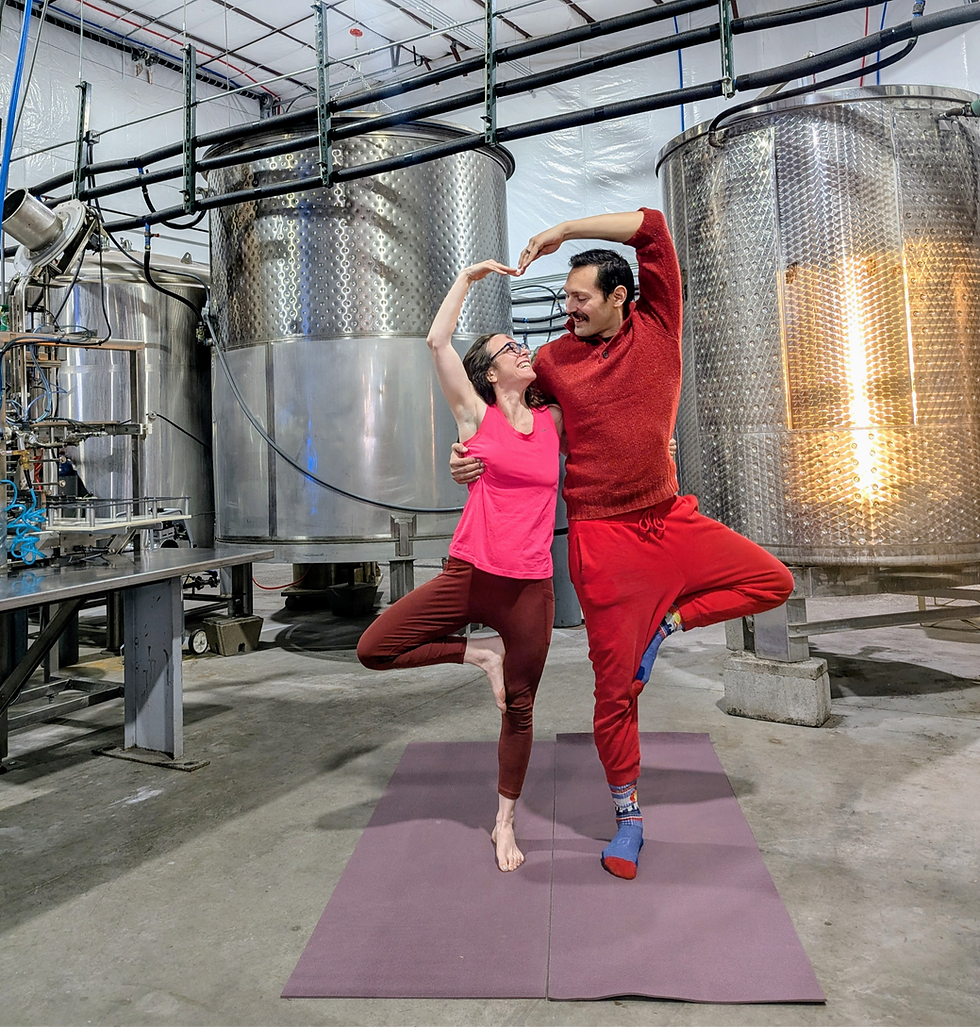
Try a standing balance pose with a partner sometime. You reach out, find each other's hands or forearms, and settle into the shape together. It feels steady. And then one of you shifts, adjusts, loses focus for a split second, and the whole thing wobbles.
Here's the thing: it doesn't matter who moved first. The moment one person wobbles, the other does too. That's not a failure. That's physics. And it's one of the most honest metaphors for partnership I know.
In a relationship, when one person is struggling, the other feels it. The question is never whether the wobble will happen. The question is what you do next. Do you grip tighter and try to force the balance back? Do you let go? Or do you soften, breathe, and find the steadiness together?
In partner yoga we practice the third option. Because balance between two people is always shared. You can't hold a pose for someone else, and you can't blame them for losing it either. You built it together and you'll find it again together.
That reframe matters a lot off the mat too.
Three Ways to Practice Together
Partner yoga poses fall into three natural categories, and each one asks something different of you.
Side by side

You're doing the same movement at the same time but independently. Cat-Cows, a seated forward fold, a breathing exercise in sync. This is the practice of being present with someone without needing to be connected. Companionship without entanglement.
This reflects the parts of a relationship that run parallel. Your separate jobs, friend groups, interests. Not everything in a relationship is shared. The connection is in returning to each other after your separate experiences and saying: here's what happened for me today.
Connected poses
Here you're connected through hands, backs, or feet, moving in mirrored shapes. This requires you to track your partner in real time, to stay soft enough to respond to their movements. It's the practice of attunement.
These poses also open up possibilities you couldn't access alone. The support of a partner lets you move somewhere new. Which requires trust. Because that's also when the wobble is most likely to happen.
Supportive poses

In these poses you have different roles. It isn't about making the same shape together. It's about one person being fully present to support the other. A gentle low back massage in child's pose. Holding your partner's hands so they can find more depth in a deep squat.
Not everything in a relationship is equal or symmetrical. We show up for each other in different ways depending on what the moment needs. This is especially true in the journey into parenthood, where some experiences are shared and some are uniquely one person's to carry. The role of the other is simply to be there.
The Communication Underneath All of It
Here's what ties all three categories together: communication. Verbal and non-verbal.

In partner yoga you are constantly reading each other. You feel tension in your partner's grip before they say anything. You notice when their breath changes. You learn to respond to subtle signals without making a big deal of it.
That's actually a skill. And like most skills it takes practice.
Most people who hesitate about partner yoga aren't worried about yoga. They're worried about looking silly in front of someone they love. Which is interesting, because that same hesitation shows up in relationships all the time. We perform competence for the people closest to us. We pretend we have it together. Partner yoga gently, sometimes hilariously, makes that impossible. And something opens up when it does.
Presence Is the Practice
Most of us spend our days in the same space as the people we love but not quite with them. We're together but distracted, present in body but somewhere else in mind.
Partner yoga asks you to close that gap. Not with grand gestures or deep conversations, but with something much simpler: your full attention on this person in front of you for one hour.
That's what makes it playful. When you're actually present with someone, things get lighter. You laugh when you wobble. You find a rhythm together that surprises you. You remember why you chose this person.


Comments